
Teak & Water: The Role of Rubber
Teak & Water:
The Role of Rubber
Have you ever wondered why teak wood is famous for boats and outdoor uses? Two of the reasons for teak’s legendary status around oceans and the wet outdoors are its dimensional stability and water resistance. You may notice that while other woods swell, warp, or rot when the rain comes, teak stays remarkably calm- that’s dimensional stability and inherent hydrophobicity. It turns out that teak has a special ingredient in its heartwood that almost no other wood has.
Teak’s ability to keep its shape and resist water is partly due to a fascinating hydrocarbon called caoutchouc (pronounced kow-chook) (Lopes et al., 2018; Thévenon et al., 2001).
What is Caoutchouc?
Caoutchouc is natural rubber (a cis-polyisoprene). Natural rubber is hydrophobic and flexible. While over 2,000 plant species produce rubber (usually as a milky latex in the bark), it is incredibly rare to find it inside the timber itself. In fact, there are only eight wood species in the world that store rubber in their heartwood, and only four that have amounts higher than 1% (Sandermann et al., 1963).
In teak, concentrations of caoutchouc can reach as high as 5% (Simatupang et al., 1996). This rubber isn’t just a trace element; it’s a powerhouse and that provides teak with an elite set of properties rarely seen in the world of timber.
Dimensional Stability
The Science of Flexibility
To understand why the flexibility of rubber matters, it helps to look at how ordinary wood behaves during humidity changes. In an average 24 hours, temperature and humidity fluctuate regularly. To an even more dramatic extent, overall humidity and temperature change greatly with the seasons. Wood swells with the moisture from high humidity and shrinks in the dry air of low humidity.
Some woods swell and shrink to a high degree. These high movement woods may become damaged from the constant size changes, creating problems for their structural integrity. A deck that is cracked can be dangerous to walk on and the boards will need to be replaced. Cladding (the protective layer of wood around buildings) that expands and contracts too much will develop gaps that allow rain, wind, and other weather to penetrate the building’s exterior. The cladding will need to be discarded and new cladding installed to prevent rot and other issues. You can expect a shorter service life from a high-movement wood.

Why Is Teak Different?
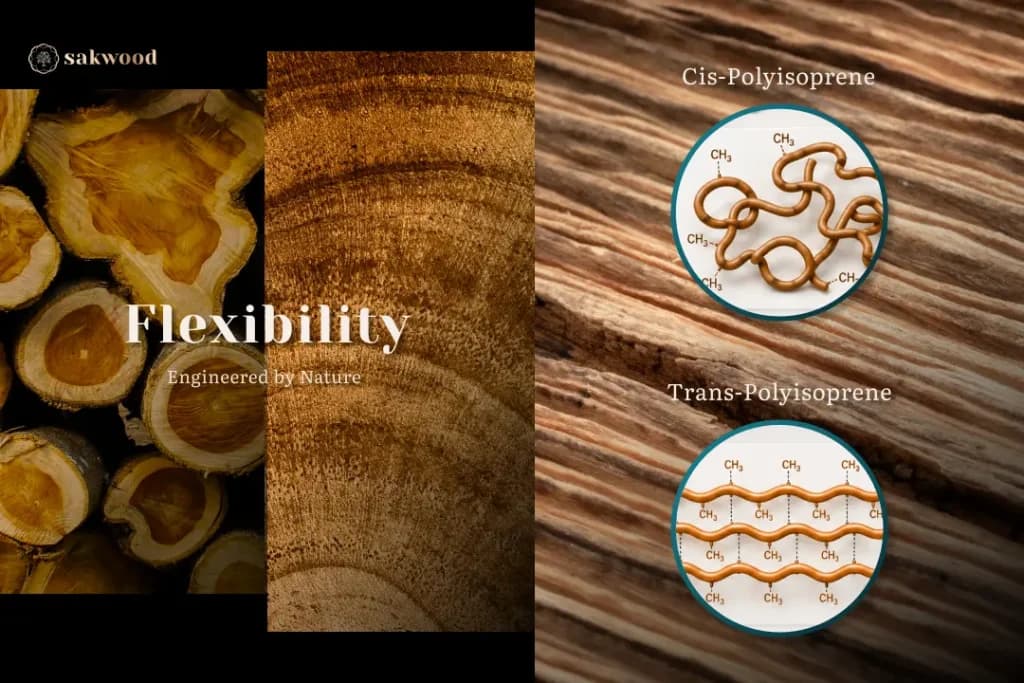
While other woods change size and crack with changes in moisture, the rubber cis-polyisoprene in teak provides internal flexibility. Think of a rubber band that you can stretch and then it returns to its original state without breaking. Did you ever wonder why that happens? It is due to the arrangement of atoms.
Cis-polyisoprene is made of long polymer chains that naturally want to be in a tangled, high-entropy “ball.” The atoms are messy, coiled, and springy. Under normal conditions, they don’t pack together tightly and they don’t crystallize.
When you stretch a rubber band (or when wood swells and shrinks with humidity changes), you are pulling those chains apart into a straight, orderly line. The long molecular chains of cis-polyisoprene naturally prefer a loose, tangled arrangement. When stretched, they temporarily straighten, but once the stress is removed, they quickly return to their original coiled state. This molecular elasticity is a key factor in teak’s remarkable dimensional stability, helping the wood recover its form rather than taking on a permanent warp.
In other woods (like Oak or Cumaru), the rigid cellulose fibers lack a flexible ‘buffer’. These molecules are bonded stiffly together in a fixed grid. When moisture enters and leaves the wood, it forces these fibers to swell and shrink. Because the arrangement is so rigid, the fibers can’t stretch to accommodate this movement. When the internal tension pulls the bonds past their limit, they snap, creating the cracks we call ‘checks.’
In teak, as the wood fibers expand or contract, the elastic rubber particles give and stretch along with the movement. This prevents the tension from reaching a breaking point, which is why a 50-year-old teak bench often has far fewer cracks than a 5-year-old Oak one.
How Dimensionally Stable is Teak Compared to Other Wood?
“Teak is tied with Redwood for #1 in the USA!”
Let’s take a look at the United States. In the USA, the Architectural Woodwork Standards (AWS) measures the amount that different woods warp or shrink. On their scale, a lower number means a more stable wood.
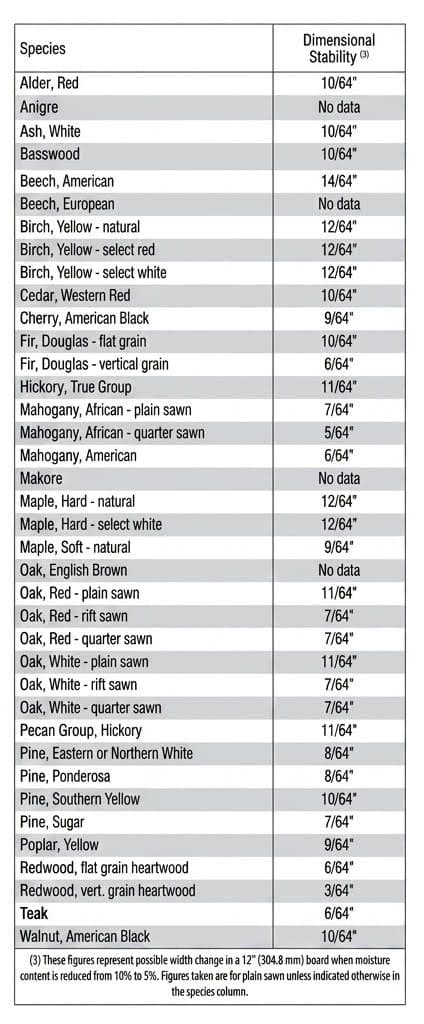
Even when tested in its most vulnerable state (Plain Sawn), Teak’s stability rating is equal to the most dimensionally stable wood in the USA: Redwood. It is twice as stable as White Oak and even beats out high-end hardwoods like African Mahogany and American Walnut.
While other woods might gap or twist over time, Teak moves less, fits better, and lasts longer.

Water Resistance
Teak has a few more tricks up its sleeve. Rubber doesn’t just give teak the flexibility to handle humidity changes without breaking, rubber also actively repels water so teak absorbs less moisture than other woods. Over the past 4,000 years, boat builders have relied on teak for this reason (Hermann, 1952). When you are out in the ocean with only pieces of wood keeping you afloat, you don’t want the wood to soak up the seas and sink into the briny abyss! You want a material that will resist the water’s pull.
A. Caoutchouc in teak wood both resists the absorption of water and repels the water. A Physical Barrier that Resists Water Absorption
Why doesn’t teak absorb water like other woods? Thanks to caoutchouc! Using Scanning Electron Microscopy (SEM), researchers found that the rubber isn’t just sitting in the pores; it is actually embedded within the cell walls (Yamamoto et al., 1998).
First, rubber in teak wood acts as a physical plug by occupying the spaces in the cells and cell walls where water would normally saturate. Think of a parking garage. If every single space is already filled by a permanent vehicle, there is simply no physical room for a new car or motorbike to enter and park.
Second, in teak wood, the rubber not only takes up the spaces, it has already expanded the spaces and swollen the cells so the cells don’t have room to expand much further (Premrasmi & Dietrichs, 1967). This is what leads to high Anti-Shrink Efficiency (ASE). The wood is swollen with rubber, so it can’t swell as much with water. Consequently, the pre-swollen cells of the wood are affected only to a minor degree when the humidity fluctuates (Puth, 1964, as cited in Yamamoto et al., 1998). The wood stays solid and stable, remaining in good condition for many years, regardless of moisture.
B. The Built-In Water Repellent
Teak does more than resist moisture from entering its cells, it actually repels water also. The reason is the Surface Energy and Surface Tension of rubber and water.
Water has a high surface tension and rubber does not. Water is a polar molecule and rubber is non-polar. Water is looking for other charged surfaces to grab onto (like the cellulose in most woods). Rubber, however, has no electrical “handles” for water to latch onto.
In fact, rubber’s surface energy is so low that water’s internal attraction to itself is stronger than its attraction to the rubber-filled wood. The result? Water pulls itself into a bead and rolls away.
→ High Surface Energy: Materials like clean glass or metal have high surface energy. They want to “pull” molecules toward them to stabilize their surface. This causes water to spread out flat (wetting).
→ Low Surface Energy: Materials like Teflon or rubber have low surface energy. The atoms are already “happy” and stable; they have no desire to bond with anything else.
When teak furniture sits out in the rain, you don’t have to worry too much about your chair becoming waterlogged and rotting. Next time you see water beading on your teak furniture, remember: you’re watching the unique, “messy” science of natural rubber at work.

Teak: The Rubber-Infused Masterpiece
When you choose teak, you aren’t just buying timber; you’re buying 4,000 years of proven natural engineering (Simatupang et al., 1995). From ancient Babylonian palaces to the decks of modern super-yachts, the rubber in teak provides:
- Dimensional Stability: It stays straight and true where others warp.
- Natural Water Repellency: No need for constant chemical sealants.
- Protective Film: Interestingly, even if you clean teak with certain solvents like acetone, the residual caoutchouc can diffuse from the inner parts of the wood to the surface, forming a thin protective film (Yamamoto et al., 1998).
- Wear Resistance: Teak possesses an extraordinarily high wear resistance. This is largely due to its natural oils and the rubber acting as a lubricating layer, which prevents the surface from grinding down under mechanical stress (Sandermann et al., 1963). For this reason, teak performs exceptionally well for floors and decks, especially on ships where there is very heavy wear.
References
Architectural Woodwork Institute (2014), Architectural Woodwork Manufacturers Association of Canada, and Woodwork Institute. Architectural Woodwork Standards. 2nd ed.
Hermann, S. (1952). Teakholz [Teakwood]. Berlin, Germany: Springer-Verlag. As cited in Importance of Teakwood Extractives on Wood Properties and for Tree Breeding. http://eprints.usm.my/33501/1/IMPORTANCE_OF_TEAKWOOD_EXTRACTIVES_ON_WOOD_PROPERTIES_AND_FOR_TREE_BREEDING.%28MER%29.pdf
Lopes, J. de O., Garcia, R. A., & do Nascimento, A. M. (2018). Wettability of the surface of heat-treated juvenile teak wood assessed by drop shape analyzer. Maderas. Ciencia y Tecnología, 20(2), 249–256. https://doi.org/10.4067/S0718-221X2018005022801
Premrasmi, T., & Dietrichs, H. H. (1967). Nature and distribution of extractives in teak (Tectona grandis Linn.) from Thailand. Natural History Bulletin of the Siam Society, 22(1–2), 1–14.
Sandermann, W., & Simatupang, M. H. (1963). Über das Vorkommen von Kautschuk in Hölzern. Holzforschung, 17(6), 161–163. (Translated title: On the occurrence of rubber in woods)
Simatupang, M. H., Rosamah, E., & Yamamoto, K. (1995). Importance of teakwood extractives to wood properties and tree breeding. Forestry and forest products research: Proc. of the third conference, 2, 235–246.
Thévenon, M.-F., Roussel, C., & Haluk, J.-P. (2001, May 20–25). Possible durability transfer from durable to non durable wood species: The study case of teak wood [Paper presentation]. 32nd Annual Meeting of The International Research Group on Wood Preservation, Nara, Japan.
Yamamoto, K., Simatupang, M. H., & Hashim, R. (1998). Caoutchouc in teak wood (Tectona grandis L.f.): formation, location, influence on sunlight irradiation, hydrophobicity and decay resistance. Holz als Roh- und Werkstoff, 56(3), 201–209. https://doi.org/10.1007/s001070050299Yamamoto, K., Simatupang, M. H., Sulaiman, D., & Hashim, R. (1998). Netsu-tai mokuzai no genchi hozon houhou no kaimei [Elucidation of local preservation methods for tropical wood]. Japan International Research Center for Agricultural Sciences (JIRCAS).